

إدراج تبريد متطابق من فولاذ ماراجينج MS1 (1.2709) | دراسة حالة لقالب الحقن البلاستيكي المطبوع ثلاثي الأبعاد SLM
إدراج قالب الحقن البلاستيكي من فولاذ ماراجينج MS1 (1.2709) بقنوات تبريد متطابقة داخلي، تم إنتاجه بطريقة الطباعة المعدنية ثلاثية الأبعاد SLM. 16+ ميناء تبريد داخلي، دقة موقعة ±0.05 مم، HRC 50–55 بعد الشيخوخة، تقليل وقت الدورة بنسبة 35%، تقليل النفايات بنسبة 50%. يستبدل التبريد بإدراج مثقوب في القوالب ذات التجاويف العالية.
Case Study: MS1 Maraging Steel Mold Insert with Conformal Cooling
Material: MS1 / 1.2709 (X3NiCoMoTi18-9-5) | Process: SLM + Aging | High-Cavitation Plastic Injection Mold
Metal 3D Printing Case Study
1. Background
A precision plastic injection molder was producing a 16-cavity thin-wall packaging part on a high-tonnage press. The legacy mold used a P20 tool-steel core with straight drilled cooling lines, and the cavity layout made it impossible to drill water lines near the gates. Result: the part warped at the corners, scrap rate ran 8%, and cooling time dominated the cycle. A conformal cooling insert in maraging steel — channels that follow the cavity geometry into the corners conventional drills cannot reach — was needed to bring cycle time and scrap rate under control.
2. The Challenge
Design requirements included:
· 16+ internal conformal cooling ports arrayed around the cavity layout, with channels that follow the cavity contour into the gate corners
· MS1 (1.2709) maraging steel — HRC 50–55 after aging, polishable to SPI-A3 mirror finish
· ±0.05 mm positional accuracy on every internal port relative to the cavity surface
· Channels with no support marks on the wetted surface (self-supporting geometry during printing)
· Through-hardening capability — uniform hardness from cavity surface to insert core, no soft spots
· Deliverable in 3 weeks for first-article trials
3. The Solution
The mold insert was redesigned with topology-optimized conformal cooling channels that wrap around the cavity layout — including the gate corners that the legacy drilled lines could not reach — and manufactured by Selective Laser Melting (SLM) in MS1 (1.2709) maraging steel powder. The SLM process printed the complex channel network, the central main inlet, the 16+ outlet ports, and the cavity-facing geometry in a single build with no brazed joints and no drilled lines. All channels were oriented to be self-supporting during printing, so the wetted surface is as-built — no support marks to break through or to seal.
After printing, the insert was stress-relieved at 490 °C, solution-treated at 820 °C, aged at 480 °C for 5 hours to reach HRC 50–55, then finish-machined on the cavity face and polished to SPI-A3. The maraging steel was chosen specifically because it hardens uniformly from surface to core (no decarburization risk), maintains dimensional stability through aging (<0.05% distortion), and polishes to the optical finish required for cosmetic packaging parts.
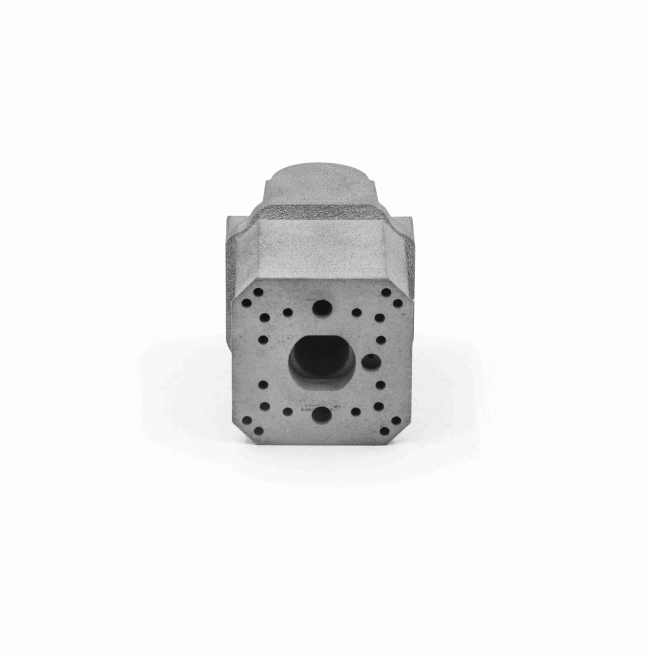
Figure 1: SLM-printed MS1 (1.2709) maraging steel mold insert — central main inlet, 16+ arrayed outlet ports, as-built wetted surfaces. After aging the insert reached HRC 50–55 and was polished to SPI-A3 on the cavity face.
4. The Result
· 35% cycle-time reduction — from 28 s to 18 s on the first optimized run
· 50% scrap reduction — from 8% to 4% — corner warpage eliminated
· HRC 50–55 uniform hardness — no soft spots, polish to SPI-A3 on cavity face
· ±0.05 mm port accuracy — 16+ channels, every port within tolerance relative to cavity
· Self-supporting channels — as-built wetted surface, no support marks to seal
· Lead time: 3 weeks — from CAD to aged, polished, ready-to-fit insert
“The conformal channels reached corners we could never drill to. Cycle time dropped by 35% on the first article, and the maraging steel polished to a mirror finish with no soft spots.”
Material: MS1 / 1.2709 Maraging Steel | Process: SLM + Aging | Application: Conformal Cooling Mold Insert