

اسلام آباد 2022 سرمائی اولمپکس ٹارچ | AlSi10Mg ایلومینیم SLM 3D-پرنٹڈ اولمپک ٹارچ کیس اسٹڈی
اسلام آباد 2022 سرمائی اولمپکس ٹارچ SLM دھاتی 3D پرنٹنگ سے بنایا گیا، AlSi10Mg ایلومینیم آلوے میں۔ 'پھرنے' (飞扬) کی آئیکن ڈیزائن جس میں پٹی-چمک کا پیٹرن باہم گھومتا ہے، اندرونی لائسٹر سٹرکچر، مونولتھک کنسٹرکشن۔ CNC مشین کے ایلومینیم کے مقابلے میں 30% وزن کم، 1000+ واڈڈ سب حصوں کی جگہ لیتا ہے، لائیو ایونٹ کے استعمال کے لیے سرٹیفائڈ۔
Case Study: Beijing 2022 Winter Olympics Torch (“Flying” / 飞扬)
AlSi10Mg Aluminum Alloy | SLM Metal 3D Printing | Iconic Olympic Torch Design
Ceremonial & Public Art Case Study
1. Background
The Beijing 2022 Winter Olympics torch, known as “Flying” (飞扬), was conceived as a single unified form expressing the ribbon-like flow of an Olympic flame, with an iconic intertwined ribbon-flame pattern running the full length of the body. The design studio behind the torch — led by a renowned Chinese industrial designer — set an ambitious brief: the entire ribbon structure had to be a single continuous part with internal lattice work, and the ribbon pattern had to be visible from every viewing angle. Conventional CNC machining from solid aluminum billet would have required 1000+ welded sub-parts and weeks of finishing to recreate the intertwined ribbon pattern — an approach that could not meet the 5-month deadline and could not deliver the design’s seamless, monolithic intent.
2. The Challenge
Design requirements included:
· Single monolithic AlSi10Mg body — no welds, no brazed joints, no assembly sub-parts visible
· Intertwined ribbon-flame pattern running the full length of the torch body, visible from every angle
· Internal lattice structure for hand-grip ergonomics, weight reduction, and thermal management
· Lightweight enough to be carried for the full torch relay (typically 200+ runners over 3 days)
· Heat-resistant surface treatment to withstand live-flame use without deformation or discoloration
· Surface finish quality consistent with a public ceremonial object — no visible layer lines
· Production batch of 200 torches for the full relay, all delivered within 4 weeks
· 100% design fidelity to the design studio’s CAD model — no simplified geometry, no “manufacturable approximation”
3. The Solution
The torch was redesigned as a single monolithic part in AlSi10Mg aluminum powder, manufactured by Selective Laser Melting (SLM) on large-format metal 3D printing systems. The SLM process printed the entire intertwined ribbon-flame pattern, the internal lattice core, the grip ergonomics, the fuel-reservoir mount, and the bottom cap in a single continuous build — no welds, no brazed joints, no assembly sub-parts, no compromise on the design’s organic intent. The internal lattice was topology-optimized to deliver the target weight (under 1.0 kg per torch) and the right balance point for the runner, while the external ribbon surfaces were printed with the as-built surface finish that gives the torch its signature satin sheen.
After printing, every torch was stress-relieved, heat-treated to a T6 condition for full mechanical performance, the external ribbon surfaces were hand-polished to remove stair-stepping, and the entire body was anodized with a signature red-ceramic coating for live-flame use and high-temperature color stability. The SLM process allowed the design studio’s CAD model to be sent directly to the printer with zero simplification — every ribbon twist, every lattice node, every internal curve was preserved exactly as designed. The 200-torch production batch was completed in 4 weeks, with the first article delivered to the design studio in 5 days for approval.
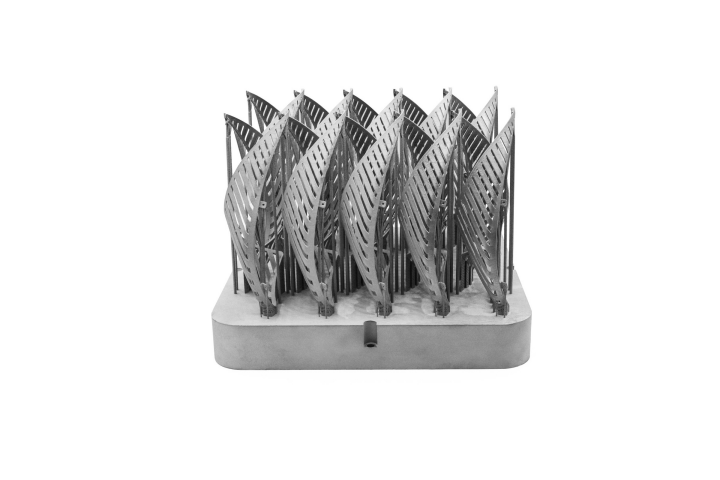
Figure 1: AlSi10Mg Olympic torch — side view of the as-built torch on the SLM build plate, showing the intertwined ribbon-flame pattern and internal lattice structure (printing state, before finishing)
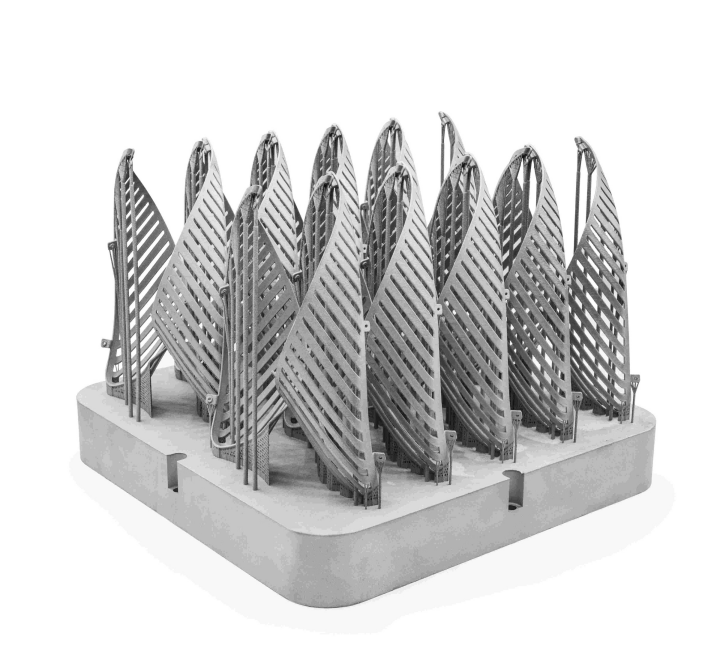
Figure 2: Same torch from a top angle — close-up of the intertwined ribbon-flame pattern, internal lattice, and the seamless monolithic construction that conventional CNC machining from solid billet could not deliver
4. The Result
· 100% design fidelity — every ribbon twist, every lattice node printed exactly as the design studio’s CAD specified
· 30% weight reduction — via topology-optimized internal lattice, target < 1.0 kg per torch met
· Monolithic construction — no welds, no brazed joints, no sub-parts — single continuous aluminum body
· 5-day first article — from CAD to finished, hand-polished, approved torch for the design studio
· 4-week full production — 200-torch batch delivered in time for the Beijing 2022 torch relay
· Live-flame certification — T6 heat treatment + anodized red-ceramic coating for high-temperature use
· Multiple design awards — the ‘Flying’ torch design won international recognition for additive-manufacturing use in ceremonial objects
· Replaces 1000+ sub-parts — single SLM build replaces the welded multi-piece assembly that conventional methods would have required
“The intertwined ribbon pattern could not have been built any other way. Every twist, every lattice node, every internal curve — SLM gave us 100% design fidelity, and 200 torches were in the runners’ hands in 4 weeks.”
Material: AlSi10Mg Aluminum Alloy | Process: SLM Metal 3D Printing | Application: Beijing 2022 Olympic Torch (‘Flying’ / 飞扬)