
Online 3D printing service
Get instant online quotes on parts in over 80 metal and plastic materials. Free shipping on all US orders. ISO 9001:2015, ISO 13485 and AS9100D certified.Start A New 3D Printing Quote
File type: STL, STP, STEP
Privacy: All your files are secure with us. Read our privacy policy.
Multi Jet Fusion is an industrial 3D printing process that produces functional nylon prototypes and end-use production parts in as fast as 1 day. Final parts exhibit quality surface finishes, fine feature resolution, and more consistent mechanical properties when compared to processes like selective laser sintering.
Common applications for Multi Jet Fusion are:
- parts requiring consistent isotropic mechanical properties
- functional prototypes and end-use parts
- complex and organic geometries with fine features
Design Guidelines for Multi Jet Fusion
Our basic guidelines for Multi Jet Fusion include important design considerations to help improve part manufacturability, enhance cosmetic appearance, and reduce overall production time.
| US | Metric | |
| Maximum Part Size | 11.1 in. x 14.9 in. x 14.9 in | 284mm x 380mm x 380mm |
| Layer Thickness | 0.00315 in. | 80 microns |
| Minimum Feature Size | 0.020 in. | 0.5mm |
| Wall Thickness | 0.020 in. | 0.5mm |
Tolerances: For well-designed parts, tolerances of +/- 0.012 in. (0.30mm) plus 0.1% of nominal length for each additional inch can typically be achieved. Note that tolerances may change depending on part geometry.
Warpage: Warpage: Larger part sizes (>7 in.) and parts with thin features are the most susceptible to warp. We recommend maintaining a uniform thickness of 0.125 in. (3.175mm) to ensure stability.
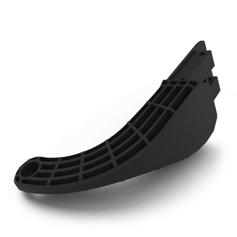
MJF Material Options
OLA TPU Black
OLA TPU is a highly versatile material known for its flexibility, resilience, and ability to produce detailed and intricate parts. It is suitable for use in cushioning applications and wearable parts. The material has passed ISO 10993-10 (skin sensitization) and ISO 10993-5 (cytotoxicity) tests, making it skin-safe.
OLA TPU White
OLA TPU is a highly versatile material known for its flexibility, resilience, and ability to produce detailed and intricate parts. It is suitable for use in cushioning applications and wearable parts. The material has passed ISO 10993-10 (skin sensitization) and ISO 10993-5 (cytotoxicity) tests, making it skin-safe.
OLA 7500 High-Performance Nylon (PA12) BK
OLA 7500 is a high-performance PA12 material optimized for MJF printing technology. It provides outstanding part quality with exceptional surface detail and dimensional accuracy, making it ideal for intricate components and complex assemblies. A preferred choice for internal structures, housings, connectors, and functional parts requiring precision.
OLA 7500 High-Performance Nylon (PA12) RAW color
OLA 7500 is a high-performance PA12 material optimized for MJF printing technology. It provides outstanding part quality with exceptional surface detail and dimensional accuracy, making it ideal for intricate components and complex assemblies. A preferred choice for internal structures, housings, connectors, and functional parts requiring precision.
Compare MJF Material Properties
| Material | Color | HDT | Tensile Strength | Elongation | Max Build |
|---|---|---|---|---|---|
| OLA TPU Black | Black | — | 1,015–1,305 psi | 130%–280% | Gray-Black (MJF): 14.84in × 10.91in × 14.96in |
| OLA TPU White | White | — | 1,015–1,305 psi | 130%–280% | White (SLS): 13.78in × 13.78in × 9.84in |
| OLA 7500 High-Performance Nylon (PA12) BK | Black | 311°F | 6,962 psi | 15–20% | 14.84in × 10.91in × 14.96in |
| OLA 7500 High-Performance Nylon (PA12) RAW color | Natural (raw) | — | — | — | 14.84in × 10.91in × 14.96in |
These figures are approximate and dependent on a number of factors, including but not limited to, machine and process parameters. The information provided is therefore not binding and not deemed to be certified. When performance is critical, also consider independent lab testing of additive materials or final parts.
Multi Jet Fusion Surface Finish
| Standard | A bead blast removes all powder and leaves a consistent overall texture. Parts are then dyed a standard black color. |
| Vapor Smoothing | Significant reduction of surface roughness from 250+ μin RA (as-printed) to 64 – 100 μin RA after smoothing. Available for PA12 Black. |
| Custom | Secondary options include a primer that can be applied as well as taps and inserts. |
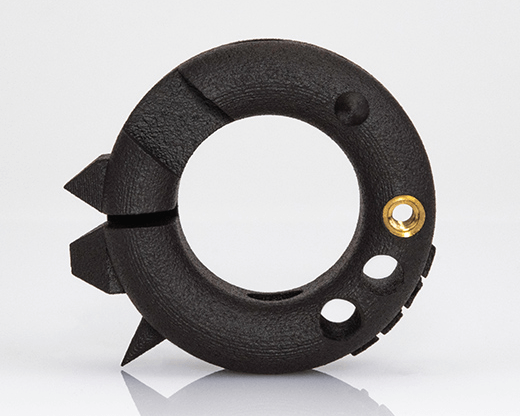
How Does Multi Jet Fusion Work?
Multi Jet Fusion uses an inkjet array to selectively apply fusing and detailing agents across a bed of nylon powder, which are then fused by heating elements into a solid layer. After each layer, powder is distributed on top of the bed and the process repeats until the part is complete.
When the build finishes, the entire powder bed with the encapsulated parts is moved to a processing station where a majority of the loose powder is removed by an integrated vacuum. Parts are then bead blasted to remove any of the remaining residual powder before ultimately reaching the finishing department where they are dyed black to improve cosmetic appearance.